Calling all sleuths! Join me May 11-15 @ClueTFF for the 2015 #TwitterFiction Festival!

Honors, News

When a college reunion ends in murder, everybody is a suspect. Who did it? Where? With what weapon?

It’s a modern-day twist on the classic Parker Brothers board game “Clue,” where the usual suspects are glued to their smartphones and social media accounts during a tense dinner party in Presidio Heights. What are they all hiding? What are they oversharing? Before the night’s end, old secrets will be revealed and new secrets will be formed.

If you have a Twitter account, feel free to interact with these colorful characters as the homicide and subsequent investigation unfold in real-time. Ask them questions. Try to trip them up. Make them confess. Can you trust what they tell you? If you don’t have a Twitter account, you can still follow along by visiting the @ClueTFF Twitter page during the festival. The whole narrative will also be published on Storify for posterity after the event.

During May 11-15, follow all the major players here:
@MrBoddyTFF
@MissScarlettTFF
@MrsPeacockTFF
@MisterGreenTFF
@ColMustardTFF
@MrsWhiteTFF
@ProfPlumTFF

For the full schedule and a taste of all the festival has to offer, follow @TWfictionfest and @TwitterBooks on Twitter during the week.


Full disclosure: I am beyond excited about being a featured writer (contest winner) for this year’s festival. However, I have never written a murder mystery before. I have also never written a multi-character story on Twitter (or any social media) before. I am beginning to think it’s a bit insane to attempt doing both for the first time, at the same time. Nevertheless, this will definitely be an adventure, and we can never have too many of those. So grab your magnifying glasses, your casebooks, and your Sherlockian nicotine patches. I hope you will join me for the ride.

Colonel Mustard in the Hall Closet with the Traumatic Childhood Memory #FLASHBACK2SCHOOL

Musings

Essay Prompt: “Write an essay somehow inspired by super-huge mustard”

As students of writing, we are constantly reminded that we should try to write an hour each day. And if we can’t manage an hour, we should still write a little bit each day, even if only in the twenty minutes that exist between our alarm clock and the breakfast table. The best reason I’ve ever gotten for this advice (thanks Aaron Reynolds!) is that we sometimes, without even realizing it at first, find inspiration in the most mundane, everyday moments: that routine trip to the dentist, the leaky bathroom faucet that needs to be repaired, a freeway traffic jam on the drive home from work. Over time, I’ve come to realize how true this is. Because many of my best stories were indeed inspired by major life-changing events, like international travel, natural disasters, and hospital stays. But sometimes these stories—including the novel that I’m currently writing—are stitched together from much smaller details. Sometimes we even find inspiration in containers of bulk-size mustard.

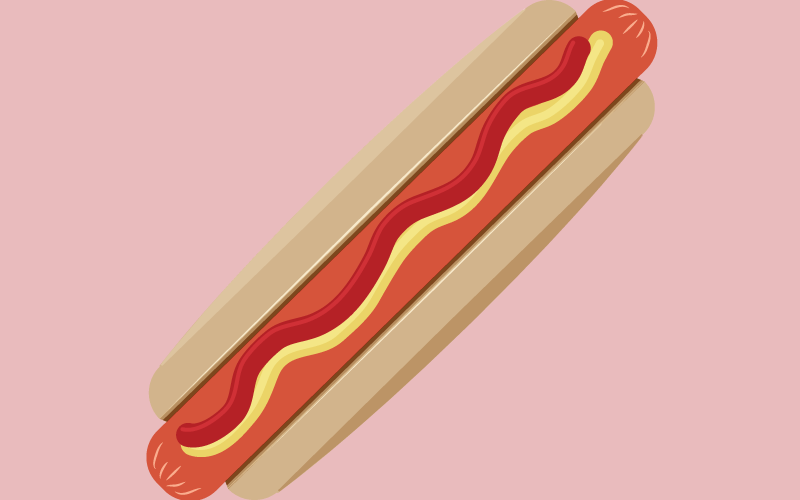
Allow me to explain. In May 2012, two separate “everyday moments” happened. Those led to the beginnings of a complex novel-in-progress, which then branched out to a comic series and a trio of short film scripts. But first, I went home for a couple weeks after my first year in grad school. One afternoon, I was having a conversation with my mother about smoothies when my dad misheard us (as he often does) and thought we were discussing movies (as we often do). I went scrambling for a pen and a piece of paper, and the seeds for my hybrid invention known as the Smoovie were planted. Fast-forward another week or so, when I was back in San Francisco for the summer. A few friends and I decided to head to Golden Gate Park during the 75th anniversary celebration to participate in the festivities.  As the evening wore on, we decided to buy food at one of the booths. The cheapest item was an extremely overpriced hot dog, which I purchased and then topped with condiments from the self-serve table displaying bulk containers of ketchup, mustard, relish, and the works.

Another week later, my summer class (the now-retired “Brevity,” taught by the incomparable Cooley Windsor) began. For my first piece, I wrote about a Smoovie that featured two dinosaurs fighting over a single foot-long chili cheese coney. It’s a fragmented, non-linear narrative that reawakens a boatload of childhood trauma for our protagonist and ends in a sinister shot of a Tyrannosaurus Rex, teeth-bared, a smear of mustard on his chin. This short piece, combined with a flash fiction piece I had written a year earlier, was the basis for this novel, which spans the course of 21 years in one boy’s life and has now grown to 65,000+ words and counting. Never mind the fact that I started such a project in a class called “Brevity,” though the story’s humble yet defiant beginnings do continue to amuse me. (Thankfully, my professor was equally amused.) The realization that a simple container of mustard could have started it all is even more intriguing. And what if I hadn’t ordered a hot dog that night? What if my father hadn’t made a comment that gave birth to an idea, which then gave birth to a disturbing, prehistoric progeny with a penchant for carnival grub? It’s likely the novel would still have existed in some shape or form as I continued to be inspired by uneventful occurrences that happened to me later that year. But it’s likely that it would’ve been vastly different in many respects. Would it have been worse? It’s impossible to say. Maybe I would’ve been hit in the head by a golf ball that summer and been inspired to even greater heights.

Nevertheless, it’s in anecdotes like this where we realize that art does imitate life. All these random, inconsequential moments lead into other random moments, causing greater moments that branch off and later prove to be life-altering—the collective whole adding up to more than the sum of its parts. Writing consistently every day ensures that we don’t let these moments slip by undetected, that we look more carefully at the things we initially deem as unimportant or uninteresting, that we allow ourselves time to be inspired by the ordinary before discarding it from our brains at the end of the day.

I know all this. I know now why the daily ritual exists. And yet, full disclosure: I still don’t write every day.

__________________

Note: This is the final essay in a 3-part blog challenge inspired by this NYT article about the new wave of creative college admissions essay prompts. Read more about the rules and logistics of the challenge and my reasons for taking it on in this previous post. There, you will also be able to find links to my other essays and those of my friends when they become available.

* Find out how Ren and Elizabeth were inspired by super-huge mustard, and thanks for following along with us this week! I have more blog posts planned for the end of the year, including some Top 10 lists (who doesn’t love lists?), so keep on keeping on.

This December, My Friends and I Are Going Back to School!

Musings

You heard me. My friends (Ren and Elizabeth) and I are hard at work on our college application essays—our creative college application essays.

Inspired by this New York Times piece on the increasingly whimsical and thought-provoking questions that elite colleges employ to stretch their prospective applicants’ imaginations, we (writers in our late 20s to early 30s) are challenging ourselves to take on some of the REAL essay questions being pondered by current high-school juniors and seniors.

We’ll be answering the same three questions and posting our essays here. Follow along—or better yet, join us.

Dec. 16: “If you could be raised by robots, dinosaurs, or aliens, which would you pick?” 

Dec. 18: “So where is Waldo, really?”

Dec. 20: “Write an essay somehow inspired by super-huge mustard.”

Here are the rules:

  • We write as our current selves, not as 17-year-olds.
  • Work in personal elements where possible (these are personal essays), but be as creative as you like.
  • Upper word limit per essay is 750 words. No lower limit.

Logistics:

  • We post our essays to our writer blogs by 5 PM Pacific on their respective due dates.
  • Link each essay back to this challenge info.
  • Once each person has posted her essay, share the direct link to that essay with the other challengers, so that we may link to essays on the same topic.

Before the fun officially starts, I have a confession to make: despite being a college graduate, I have never written a college admissions essay!  Why? The only university I applied to when I was a senior in high school simply didn’t require it as one of the application materials. I did also apply to the Honors College within the university, but their requirement of a generic “writing sample” allowed me to submit an excerpt of a retrospective short story I had been writing about a girl who drops out of a high school. It was written in the first person like a personal essay and I made sure to include a note that made it clear the piece was a work of fiction. To this day, I have not finished that story, but it wasn’t the only piece of fiction I wrote back then with a dropout as the protagonist.  I guess you could say it was somewhat of a fantasy for me back in those days—even my contribution for the writing portion of our TAKS exam* was about someone who had dropped out of college in her freshman year but couldn’t bring herself to come clean to her parents. Once again, I had to preface it with a note stating that the best way I felt I could answer their prompt was through this imagined scenario. This pseudo-essay was ultimately deemed “highly effective” and given a 4, the highest possible score.

To add to my clearly complicated memories of high school, popular culture in America has always treated The College Admissions Essay as some sort of rite of passage for teenagers transitioning into adulthood.  There is so much focus on it—not only in the news but also in the fictionalized stories we discover in YA novels and teen soaps.  Everyone is struggling to figure out what to write, how to define him or herself, and how to stand out from the rest of the pack as they vie for acceptance into their so-called “dream school.” As school was certainly not something I dreamed about with anything resembling positivity in those days, this very notion was foreign to me. Of course, when I started applying to graduate schools six years later (this time around, I applied to 8 separate schools and got into 4), I wrote plenty of personal essays. But by that time I was no longer a teenager—I was a completely different person at a completely different stage of my life.  It was not the same.  And for personal reasons I won’t waste time delving into here, I also refused to walk at my high school graduation. So yes, despite (begrudgingly) completing all the necessary credits and passing the exit exam with flying scantrons and #2 pencils, a part of me did feel that perhaps I never really graduated from high school.

I was personally inspired by and a bit envious of the situation described in the New York Times article because some of these newer, more delightfully bizarre essay prompts are exactly the type of thing that invite and reward creativity and innovative thinking, one of the few things I excelled at in high school. While my friends and I were conceiving the idea for this blog series, we did briefly consider writing our essays as our teenage selves. The idea appealed to me; however, I was such an unbearable and obnoxious person back then (as I am constantly reminded of any time I read a blog post written back in those days—some of these things still exist online!) that I felt such an undertaking would be counterproductive. At the same time, I make the promise to approach my essays with a certain amount of innocence regarding the future and what it might mean for me as I go “back to school.”

* The TAKS (Texas Assessment of Knowledge and Skills) is the 5-part exit exam everyone had to pass in 11th grade to graduate from a public high school in Texas back when I graduated from high school in 2005.  It replaced the TAAS test that most of us had been raised with, and is currently being phased out by the STAAR (State of Texas Assessments of Academic Readiness) test. I believe the writing prompt for that year was about the ramifications of keeping secrets.

Deep in the Heart

Excerpts, News

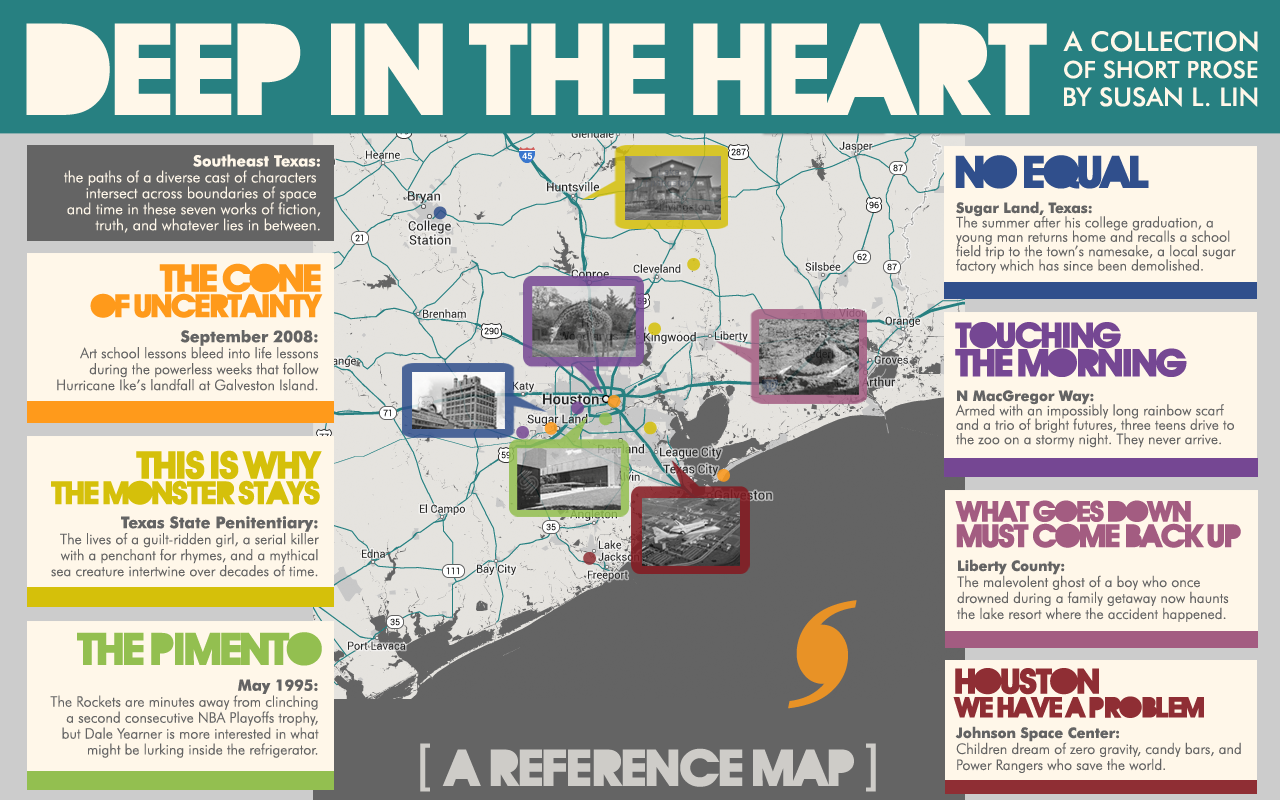
Susan Lin - deep in the heart map

[ full size ]

Here’s a look at an ongoing mapping project I’m working on in conjunction with my in-progress collection of short fiction and CNF taking place in or around my hometown of Sugar Land, TX.  I created this first draft for my final project in the “Maps and the Geospatial Revolution” course (taught by Dr. Anthony Robinson at Penn State) that just concluded on Coursera.  Next month I’l be taking the “Dino 101: Dinosaur Paleobiology” course out of the University of Alberta.  I expect I’ll have much inspiration for my novel as a result of that class.  Speaking of which, the first excerpt for Tyrannosaurus Rexia has surfaced online at Ghost Town.  Go check it out: A Lifetime Spent Documenting the World

Check out what I had to say about my map below:

As a writer whose work is heavily influenced by place and location, I set out to create a map that could act as a companion to an in-progress collection of short fiction and creative non-fiction set in and around my hometown of Sugar Land, Texas.  I moved to the west coast two years ago with the plan to attend graduate school and work on a novel set primarily in the California wilderness. And yet, when I arrived I found myself writing constantly about the very place I’d just left. During my first week, I visited the Oakland Museum of California and found Gene Autry’s “Deep in the Heart of Texas” on a jukebox in their historical exhibit and immediately set it to play. I don’t think I realized how much I loved my home state until I wasn’t there anymore.

Currently, the map contains short synopses of each work and attempts to plot out crucial points of interest throughout the region using a color-coded system.  As I mentioned briefly on the side column, my goal was to show in a dynamically visual way how all these characters from disparate circumstances and situations and time periods exist in and share the same space, their paths in life overlapping.  I’m a firm believer of the notion that while we take away a piece of a place wherever we go, we also leave a piece of ourselves there.  The Earth forgets nothing.

In print, this map will act as both a reference guide and a table of contents with page numbers at the beginning of the book.  On the web, the possibilities are endless.  Once implemented online, the map could link directly to each piece and be an interactive tool for the reader, featuring more pop-up photos and zoomed in locations. It would also have the potential to evolve over time if I decided to write more pieces about the region and plot additional points, for example.  In the future, I hope to create more detailed maps for each individual story in the collection.

The base map was created using Google Maps API Styled Maps Wizard and then laid out and designed with Adobe Photoshop.  Some of the plotted photographs are from my own collection; others have been appropriated from the web.

Also, you may have noticed I haven’t posted a new installment of “As Seen on TV” in a couple weeks.  This does not mean I won’t be writing these posts anymore, but that particular series is on hold as I explore other distribution options.  I will say that since my last blog on the subject, Dexter (particular Julie Benz, which is ironic since I’ve had an irrational aversion to her since she appeared on Roswell) has completely won me over.

As Seen on TV

As Seen On TV, Musings

I’ve decided to start blogging again.  Posts may initially be short and somewhat irregular, but I’ll be working up to what is hopefully a more reliable schedule. My goal is also to write more posts that are informative to a wider audience and not strictly personal.

I just graduated from California College of the Arts with my MFA in Writing this past May, and in the weeks since then I’ve had a lot of time to think about where I want to go next, both in terms of my writing and my overall career.  I’ve always wanted to work a TV-related job, but I think what held me back in the past was not knowing how to make that happen.  Now that I’m living near L.A. and have some more experience with screenwriting under my belt, I finally have a chance to start making this happen.  In the coming weeks I’ll be reading a teleplay from a current or past show that I admire on Sunday and spending the rest of the week analyzing its parts, (re)watching the final episode it spawned (if at all possible), and figuring out why it works well and what could be better.  I hope to blog about this weekly.  For the first week, I’ve chosen an early draft of the pilot episode of Supernatural, written by Eric Kripke, which was first included in the season 1 DVD set.  The first five seasons make up one of my favorite television shows and I’m looking forward to exploring it on a deeper level.

What is it about writing for television, particularly cable television, that appeals to me?  Strangely, although I’ve always loved television and dreamed of having a job in the industry, I didn’t think I would enjoy a job behind the scenes in the writers’ room.  Why?  Because as a fan and active participant in various fandoms over the years, I’ve seen how crazy the rabid fans can get.  It’s impossible to please everyone, and the ruts that happen every once in a while are often blamed solely on the writers, who get all sorts of hate on various modes of social media.  Not only are these writers trying to please the fans, but they are trying to please the network and keep the ratings up.  Not only that, but they are trying to create an organic and continuous story that appears in that magic little light box for a short time once a week, never knowing when the plug might get pulled before they have a chance to end the narrative on their own terms. Not only that, but they must compromise and work well with a large group of other writers.  And yet, I find that these seemingly negative points are challenges that I can learn from.  Not to mention that I love to work collaboratively with other people; writing fiction is far too solitary.  Ultimately, there is something fragile about writing in a serialized format that you can’t get with writing films or novels, something special about viewing the ever-fluid and unfinished product as it plays out on screen.

A lot has happened since my last post and I intend to write about those things as well: the projects I’ve completed, the ones I’ve only started, and the ones that are planned for the near future.  Until then.

Gonna Make It Through This Year

Inspiration, Musings, News

(This is why people like me should not be allowed to start blogs. I now have at least 7 or 8 and I hardly ever update any of them.)

The One Thing That Stays Mine

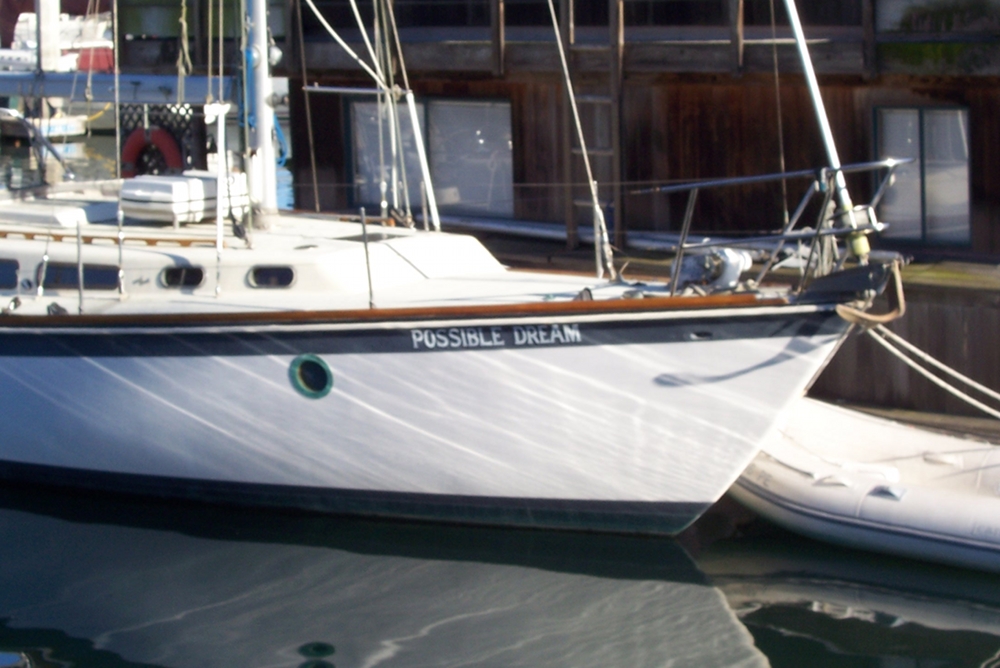
I saw this boat named Possible Dream in Santa Barbara on New Year’s Day and it seemed like a sign of good things to come.

When I was younger I always thought New Year’s resolutions were somewhat lame.  After all, the break between one year and the next is a rather arbitrary one that doesn’t really mean anything.  Nevertheless, I made two resolutions in 2010: to start flossing every day & to get published.  I accomplished both.  In 2011, I made one resolution: to finish my novel Touching the Morning.  I can say that that didn’t really happen, although I did get halfway there and I ended up writing about 100,000 words last year, which I’m sure shatters all previous personal records to put it mildly.  On the downside, I didn’t get any new publications.  To be fair, I hardly submitted anything, but that’s kind of the problem–that you either have time for one or the other, and not both.

This year I again make one resolution, which is to try harder to be my real self around other people.  I hardly recognize myself when I’m in a public setting, and I need to work on that.  Aside from that, I guess I would just like to get some serious work on my other novel (not that aforementioned one, frankly I don’t have much hope for that one anymore) and to take advantage of all the opportunities that are presented to me.

I might or might not be in grad school now.  I didn’t want to say anything about it when i was applying, but you know, these things happen faster than you can say WTF.  I love my new school almost as much as I love food!

The Fire Tree

Excerpts

As promised, here is one of the earliest excerpts of the novel I’m currently working on.  I wrote this part in high school, most likely around 2004.  It was initially a short story called The Fire Tree but the title has changed several times since.  I cut out this particular slice of backstory completely.  Originally the protagonist was an artist but then I made her brother an artist instead.  Now, no one in the story is an artist, so I guess it’s safe to post.  Trees remain an integral part of the story however.

When I was 13, my art class spent 3 months painting trees with opaque watercolors.  Pine trees, oak trees, ferns, and various bushes I don’t even know the name of.  You say it, we painted it.  The first two weeks were all technique.  Then we painted landscapes for two more weeks.  The first day we went outside to paint from direct observation, the wind was out of control.  Leaves were blowing everywhere, and my easel kept toppling over, threatening to fall on me every five minutes.  Cars drove by on their way to the building and we got some strange looks.  I felt strangely at home there, regardless.

I never looked at a tree the same way again.

I might as well admit that that part is largely autobiographical since I did do that in one of my art classes when I was younger.  Another reason to cut it out.  I’m going to be posting an old video next, because I don’t think I ever posted it, and there will be reminiscing.

This Is Not An April Fools Joke!

News

So March has come and gone, and my final word count for my novel tops out at 12,697. Considering my original goal was 30,000 words, one might view this outcome as ultimate failure. However, it’s still much more than I usually write, especially when I have no assignment due. Also taking into account the number of words I wrote for other projects, I think I’m doing as well as can be expected. Change doesn’t happen overnight, in case I didn’t mention that in my last post.

I also found some of my earliest drafts of this novel, back in 2003 when it was called The Fire Tree. The name has since changed about seven times. So have the characters’ personalities their circumstances and conflicts with each other. The basic premise however has remained the same. I’m thinking of pasting one of those excerpts in this blog at some point. Maybe. It’s pretty interesting to go back and look at now.

1,000 Words A Day

Musings

There I go, not updating again when I didn’t even finish my post from last time! If you’ll remember (or just scroll down to the previous entry) I had ended with a quote from something I’d written when I was fifteen. When I first went back to read this journal about five years later, the summer before my senior year of college, I think I recognized that entry as a defining point in my life as a writer. Because as I recall, I did not “write my heart out” that summer. As I recall, it was actually long time before I wrote anything substantial again, outside of a class assignment. As I pointed out so astutely eight years ago, something had changed about writing for me. I was hypercritical of everything, and I only saw the flaws. When I was a child, I could fill notebook after notebook of scribbled stories that made no sense, paying absolutely no attention to grammar or spelling. I was just getting those words on the page as quickly as they came to me, and they were always coming.

Needless to say, it isn’t like that for me now. I have always prized quality over quantity, and prefer books and stories with sparse but evocative language. Such is my style, which is why I write short-shorts and prose poetry and novellas. However, there is something to be said of banging out a certain number of words per day, whether or not they’re complete crap. To this day, I cannot understand how some people do it. Am I insanely jealous? Absolutely. Even if their writing isn’t that great? You bet. I’ve attempted NaNoWriMo 3 times in my life. Once was in 2002 when I was fifteen. I got about five pages into my story before I lost interest. The second was in 2009 when I was twenty-two. I believe I lost interest after two pages, which was rather pathetic, although that story did wind up being the short I published in Rougarou last fall. The third time is still ongoing this month (I was busy last November) and while I’m doing okay, it has still been a disappointing exercise for me. The month is almost over, and I’m currently sitting at around 11,750 words. Compared to my first two attempts, I suppose this is an accomplishment. However, I promised myself 1,000 words a day, and that clearly hasn’t quite been happening. Well, I guess change doesn’t happen overnight. Something I can perhaps take pride in: The longest continuous work I’d ever written was around 16,000 words, for some horrible sci-fi comedy I wrote when I was 10-11. Sad, right? Yes, but I’ve officially surpassed that now with this current story as I already had 5,500 words written before now. Add that to the 11,000+ and perhaps I really am capable of finishing a full-length novel someday. Small victory, but I shall take it. Another thing to take into account is that I’ve actually written 15,000+ words this month, because I’ve been working on another story at the same time. Let’s not even get into how many words I wrote in January and February. Math is no longer my forte.

But my point is, regardless of whether I’ve reached my goals, things might finally changing around here.

Diary of a Young Girl

Musings

Recently, I have been cleaning around the house and so I’ve been reading some of my old notebooks and journals. Sometimes they are funny, sometimes embarrassing, sometimes quite insightful. I especially love some of my opinions on writing and art. Here are a few excerpts.

June 11, 1996: …My stories Always come out confusing don’t they. Well at least I wrote it with my imagination and it a good story…

Yeah, I sound brainwashed. I should note that that was written on my 9th birthday. Here’s another:

January 31, 2000: …Writing’s a lovely subject. Writing is hard. When you finally think the story is going well, you just sort of lose it. Is this how all authors felt when they were 12? Is this how they feel now? Argh. I say that a lot nowadays. I can’t help it…

I should mention that the longest continuous work I’ve ever written I penned when I was 10-11 years old. This is a fact that depresses me often, but I hope to change it this year. It is one of my resolutions for 2011, in fact: to finally finish a full-length novel, or at least get past the 20,000 word mark in a single story. Fast forward a few years to age 15:

May 25, 2003: I’ve been writing a lot less in the past few weeks. It feels weird for me to not write (yes, I’m aware that I’m splitting infinitives, but it sounds better that way, so there.) Here’s the deal. I love to write. it is one of my favorite things to do, third only to visual art and dance. But now I can’t stand reading any of it. All I see are the flaws, and lately they’re everywhere. Time ceases to exist when I’m drawing or designing. I can be working on something for hours without even realizing it. I never felt that way about writing. […] I always told myself writing was the only way I could be another person while still being me… I’m determined to go back to writing and to how it used to make feel–that I could do anything. This summer I’m going to write my heart out. If it wasn’t meant to be then it wasn’t. But I’m not going to go down without a fight. I love life too much and I want to write too badly to see it end like this…

First of all, I should mention that I was disgustingly emo in high school and everything I wrote was dripping with teenage angst. I assure you that I was never suicidal, even if those last few sentences sound highly suspicious. But as I said, I loved life too much to ever think about dying. In fact, I have always been afraid of death. I had a strong reaction, reading this entry just now (It was titled “get it together”) but I will save my thoughts for the next entry because they could get quite long.